 ROMANIA · INOUT
The setting and the complete result
There was no search through hundreds of settings to pick this headline. We fixed the stake and fifth-step exit before the first paid start, then retained all ten attempts. The purpose was to understand how a paid round, an automatic first step and a cashout fit together.
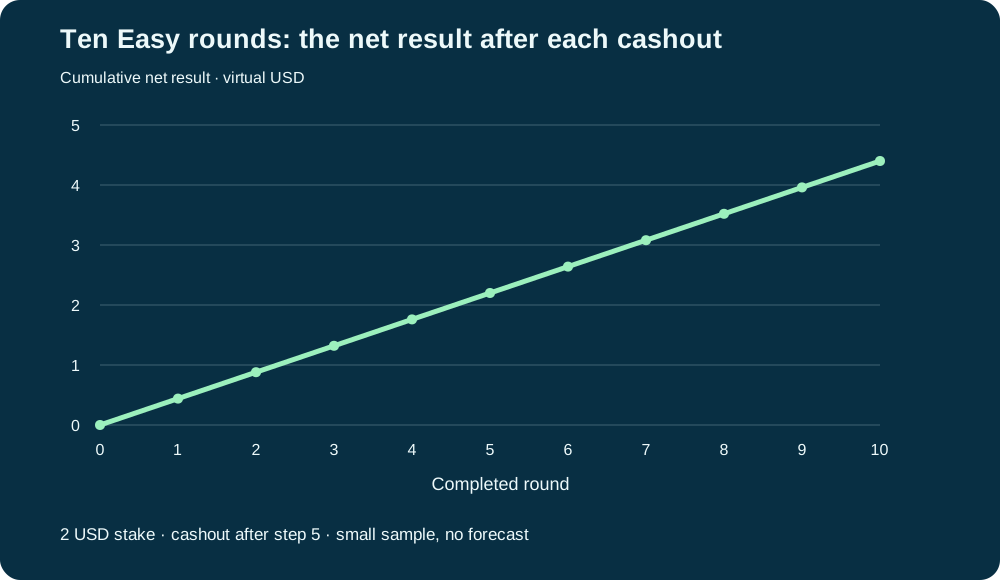
Each round staked 2 virtual USD, advanced through five successful positions and returned 2.44 USD. The original stake is included in that amount. The net gain was therefore 0.44 USD per round and 4.40 USD over the whole sequence. The demo balance moved from 1,000,000 to 1,000,004.40 before a later reconnect.
Swipe sideways to see every column.
| Round | Stake | Return | Net | Closing balance |
|---|---|---|---|---|
| 1 | 2.00 | 2.44 | +0.44 | 1,000,000.44 |
| 2 | 2.00 | 2.44 | +0.44 | 1,000,000.88 |
| 3 | 2.00 | 2.44 | +0.44 | 1,000,001.32 |
| 4 | 2.00 | 2.44 | +0.44 | 1,000,001.76 |
| 5 | 2.00 | 2.44 | +0.44 | 1,000,002.20 |
| 6 | 2.00 | 2.44 | +0.44 | 1,000,002.64 |
| 7 | 2.00 | 2.44 | +0.44 | 1,000,003.08 |
| 8 | 2.00 | 2.44 | +0.44 | 1,000,003.52 |
| 9 | 2.00 | 2.44 | +0.44 | 1,000,003.96 |
| 10 | 2.00 | 2.44 | +0.44 | 1,000,004.40 |
Download the 10 recorded rounds (CSV) The CSV contains stakes, returns, net results and settled balances. It does not contain session credentials or predictions. The reconnect that reset demo credits sits outside the ten-round ledger and is not counted as a win or loss.
A 122% observed return is 24.40 divided by 20, multiplied by 100. It is not the game’s theoretical RTP. Ten rounds can produce a tidy-looking line while saying very little about the long-term distribution.
What a profitable graph leaves out
A rising line can make a short test feel more complete than it is. Our line has ten points because ten rounds were settled. It contains no missed target, no completed jackpot and no extended losing sequence. Those absences describe the sample; they do not prove those events are impossible.
The same 4.40 USD net result could have been reached by another sequence with larger swings. Net profit describes the endpoint. Drawdown describes the fall from an earlier peak while getting there. For our recorded sequence the observed drawdown is zero, but that is not a risk limit for future play.
Rule 1: fix the stake before judging the exit
A fixed stake makes a record readable. At 2 USD every loss would cost 2 USD, and every successful 1.22× cashout returns 0.44 USD net. You can see whether the exit is being reached without a changing stake disguising the sequence.
To repeat the input settings in the demo, select Easy while idle, set 2 USD, press Play and wait for the first successful step. Press GO four more times only if the round remains active, then collect at 1.22×. A failure before that point ends the attempt; it must remain in the record.

A smaller fixed stake would reduce the size of each monetary result. It would not, by itself, establish a different chance of surviving five steps. It may also place the game in a different progress bucket, so bonus progress should not be silently copied between stake levels.
Using a 100 RON notional budget with a 5 RON stake gives room for twenty complete lost stakes before the budget is exhausted, ignoring returns. That is an arithmetic example, not a recommendation to spend the whole amount. The calculator can show the same calculation for a budget you choose.
Rule 2: choose an exit, then count every failure
An exit at 1.22× looks modest next to a 25× final chest. The lower number is available earlier, but the only way to evaluate it is to include rounds that never reach it. Counting only successful cashouts makes almost any rule look attractive.
Consider a simplified ordinary round that either pays 1.22 times the stake or pays nothing. Its break-even success rate would be 1 ÷ 1.22 = 81.97%, before separate feature value or adjustments. This is a threshold the rule would need; it is not an estimated probability supplied by the game.
With ten equal stakes, eight wins and two losses would return 19.52 USD from 20 USD staked: −0.48 USD net. Nine wins and one loss would return 21.96 USD: +1.96 USD. Our ten wins returned 24.40 USD. These counterexamples show how quickly one or two missing losses change the story.
One 2 USD loss consumes the gains from slightly more than four 0.44 USD wins. After four wins and one loss, net is −0.24 USD. After five wins and one loss, it is +0.20 USD. Small frequent cashouts can therefore feel safer than their cumulative accounting actually is.
Do not infer the next step’s success chance from the multiplier ratio alone. The game also has separate progress and feature rules, and our ten-round record is not a complete probability model. A future validation needs a larger, independently recorded sequence with the rule fixed in advance.
Compare targets without inventing unplayed rounds
Changing from step five to step ten would create a different rule. We cashed out at five, so our ledger does not contain an actual step-ten settlement for any of these rounds. A later position exposed in a finished response is not the same thing as having placed and settled that alternative bet.
A useful comparison needs complete observations under the new rule or an explicitly defined replay model. It must state which prices, features, stake caps and rounding rules it reproduces. Merely drawing a second profitable line and calling it a simulation would not supply that missing evidence.
The button label also matters. A target described as “five clicks” is ambiguous because Play already initiates the first step. Write “five successful positions, then cashout” instead. It gives another reader a setting they can reproduce without accidentally taking a sixth step.
Rules 3 and 4: stop limits and recovery stakes
A stop-loss decides how much of a session you are willing to expose before ending it. A take-profit decides when to stop after a gain. Neither changes the outcome of a step already in progress. The first practical benefit is a decision made before excitement or frustration takes over.
Define whether the limit uses net result or total stakes. These differ: ten stakes of 2 USD are 20 USD turnover, while our net result was +4.40 USD. A “20 USD limit” is ambiguous unless you say which number it controls.
If a session stops and then restarts, its previous loss has not disappeared. Record the restart as a new segment and retain the combined total. Otherwise, repeated resets can make a losing evening look like several harmless short sessions.
Doubling after a loss is especially easy to misunderstand at a 1.22× cashout. If 2 USD loses, a winning 4 USD stake earns only 0.88 USD net. The combined result remains −1.12 USD. “Double and recover” is not even arithmetically true at this multiplier.
After one 2 USD loss, recovering that loss alone with a 0.22-per-unit net win would require more than 9.09 USD on the next successful round, before rounding. Recovering the loss and adding the original 0.44 USD target would require about 11.09 USD. Another failure increases the exposure further.
We did not encounter a losing round in this short sequence, so it cannot validate a loss-recovery system. A comparison that celebrates a martingale here would have tested none of its defining behaviour. The fixed-stake record is all that was actually played.
Write the restart rule before stopping
Consider a hypothetical 40 USD session with a 6 USD loss limit. After three complete 2 USD losses, the stop is reached. If you immediately call the remaining 34 USD a new session with the same limit, the original evening can still lose another 6 USD. The label reset does not restore the missing money.
A useful restart rule specifies a separate time, a fresh budget decision and a combined ledger. “Restart when I feel the next one will win” supplies none of those. This is about recording exposure accurately, not a claim that a waiting period changes the game’s probabilities.
Stops can also be crossed rather than hit exactly. If net is −5 USD before a new 2 USD stake, a complete loss ends at −7 USD. A 6 USD threshold alone does not prevent that overshoot. Decide whether another stake is allowed when it could exceed the chosen limit.
Rule 5: treat bonus progress as a separate decision
One pearl appeared during our sample. It was recorded as feature progress, not an extra cash payment. No jackpot or free-spin round completed. Adding an expected jackpot to the observed 24.40 USD would turn measured accounting into an unsupported estimate.

The game stores progress by stake, currency and difficulty. Before increasing a stake to chase a feature, check which meter you are looking at. A partially filled meter at one setting should not be assumed to apply to another setting.
The cost already spent reaching a meter position is gone. The next useful question is the cost and uncertainty of continuing from here. Our recording does not establish how many future rounds a remaining pearl will take or what a finished roulette selection would pay.
Keep three columns in a personal demo note: ordinary round return, visible feature progress and completed feature return. A pearl belongs in the middle column. A paid bonus result belongs in the last only after it is settled. This avoids inflating a strategy result with colourful animations.
The help’s storage statement also does not turn a meter into a deposit account. Browser sessions, operator implementations and demo resets can behave differently. Record the settings and current state instead of assuming a reconnect preserves every visible number.
What would make this strategy worth another test?
First, keep the same ordinary game, mode, stake and exit. Second, start a new sample without discarding its early losses. Third, set a round-count or exposure limit before play. Finally, compare the complete result against the original ten rounds instead of splicing together the profitable parts.
A new sample should include how often the target was reached, total staked, total returned, net result and largest observed fall from a previous balance peak. Ten cashouts with no fall are not evidence that future drawdown is zero.
Our present record cannot estimate rare final-chest outcomes, jackpot frequency or the profitability of changing modes after a streak. Those require events this sequence did not contain. A prediction app that claims to fill those gaps without showing a verified mechanism is not supported by these data.
For now, the most useful result is concrete: you can reproduce the settings, understand that 2.44 USD includes a 2 USD stake and recognise why a single loss matters. Use the demo to learn that accounting, then inspect account conditions separately if you decide to explore partner games.
A compact demo record you can keep
Write the date, ordinary game version, currency, difficulty, stake, target step and intended number of rounds before the first start. For each attempt, record whether the stake was accepted, whether the target was reached, the settled return and the closing balance. Keep interrupted or uncertain attempts separately until resolved.
At the end, add every accepted stake and every settled return. Subtract the first total from the second. Do the same calculation from the start and finish balances only if no reset, top-up or other transaction occurred between them. These two totals should agree in a clean session.
Finally, write what the run did not test. That small note prevents a later reader from treating a control demonstration as a complete comparison of difficulties or a verified predictor. It also makes the next test easier to design: you know which questions remain unanswered.
Fish Road questions
What was profitable in the recorded Fish Road sample?
Easy, a 2 USD stake and a fifth-step cashout at 1.22× returned +4.40 virtual USD across ten completed rounds. This is a short historical result, not a future-profit claim.
Can I use a predictor to repeat those wins?
The sample does not expose future outcomes. A predictor label or a streak on a graph supplies no verified next-round signal.
Does the 96% RTP mean I lose exactly 4%?
No. The provider’s theoretical RTP concerns long-run return under its model. A short session can finish well above or below it.