 ROMANIA · INOUT
1. Read the screen and place the first stake
Fish Road is not a conventional reel slot. There are no paylines to choose and no five-reel spin to resolve. A fish advances through an underwater route. The buttons let you choose a stake and a difficulty before a round, then decide between another step and a cashout while the round remains active.
The wallet in the demo’s bottom control bar holds virtual credits. Our session used USD and began at 1,000,000 credits. That generous starting balance makes controls easy to inspect, but it can make a 2 USD loss look irrelevant. It is not a sensible personal budget and cannot be withdrawn.
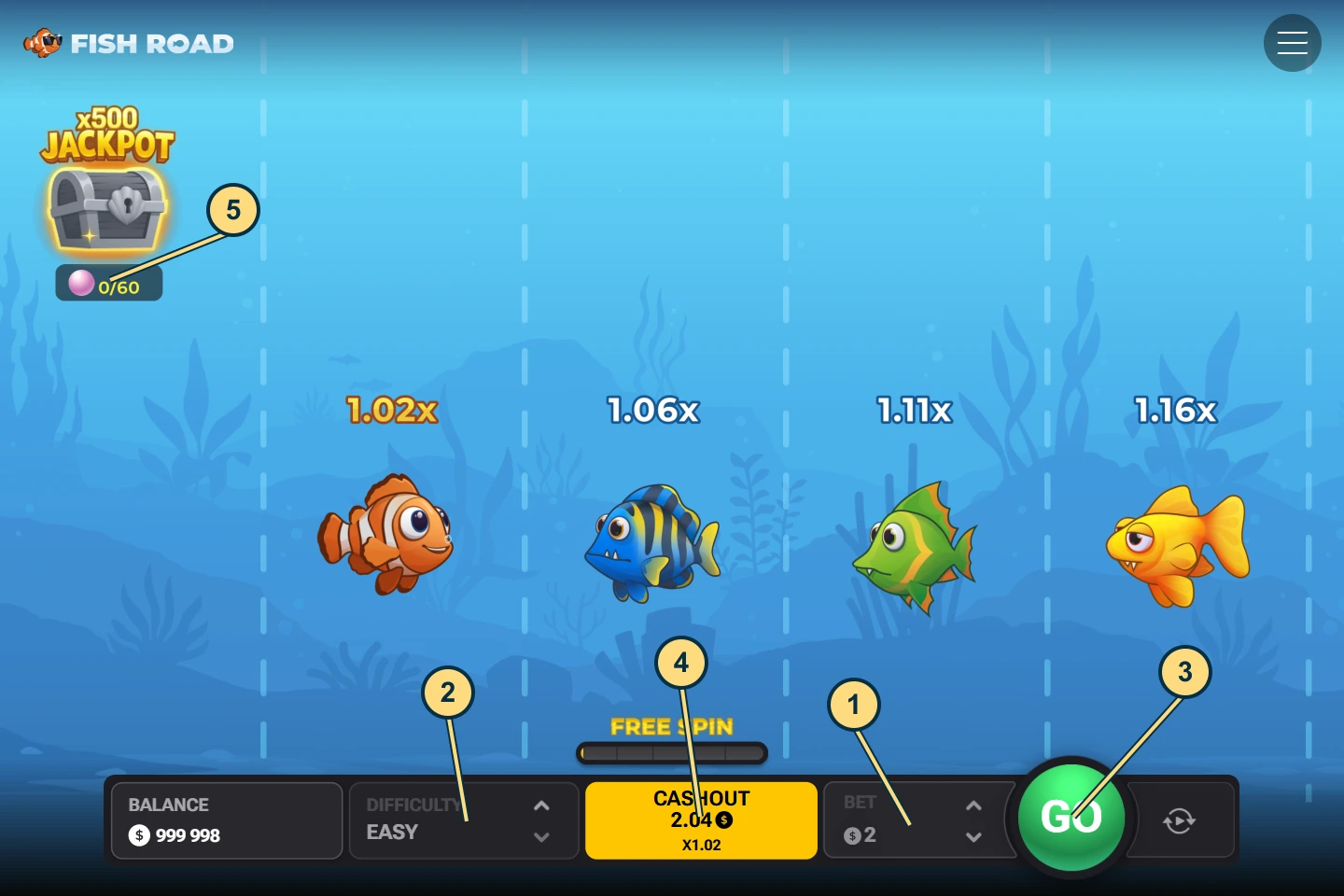
Choose the stake while the round is idle. The inspected USD configuration accepted amounts from 0.12 to 200, with 1, 2, 5 and 10 quick-select buttons. These are the values in this demo, not a promise that every operator offers the same limits or accepts Romanian lei.
Now choose the difficulty. Then press Play once. In our capture, this deducted the stake and automatically advanced the fish through its first step. Do not count that as a free movement before the round. If you plan to stop at step five, you need four further successful GO actions after the initial step.
A round has started when the stake is accepted, not merely when a finger touches the screen. Wait for the interface to respond before deciding what to do next. Network delay does not give you a second version of the same result or make repeated taps a prediction technique.
2. Separate the cashout from the profit
After a successful step, the cashout button shows the return currently available. This amount includes the stake. For example, 2 USD at 1.22× returns 2.44 USD. Subtract the 2 USD originally deducted and the round’s net result is +0.44 USD.
If the fish hits an enemy before you collect, that round returns zero and its net result is −2 USD at the same stake. Your loss is not the larger amount that a later successful step might have paid. However, continuing does give up the chance to collect the amount currently on the button.
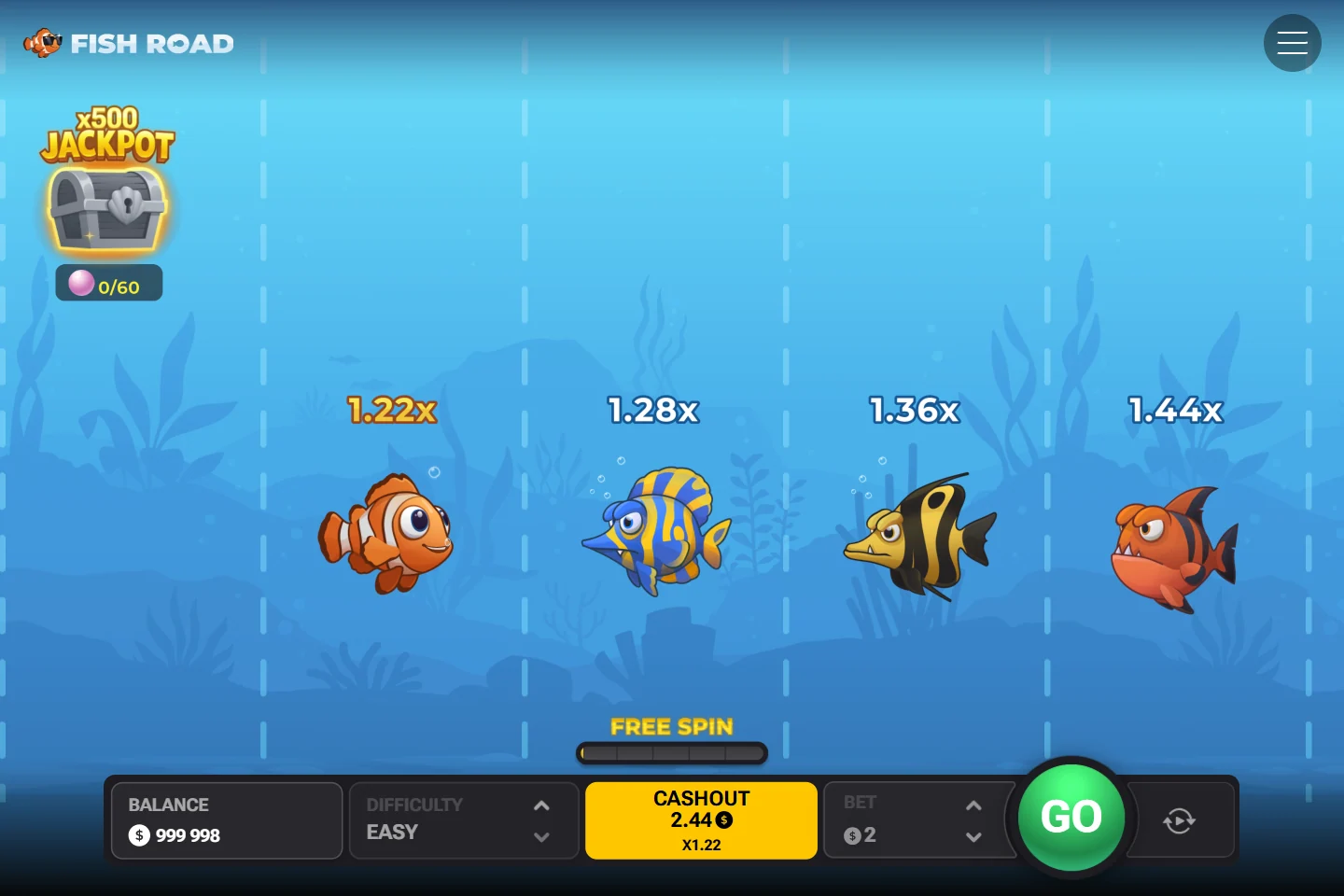
Suppose a 10 RON arithmetic example uses a 1.22× cashout. Its gross return would be 12.20 RON and net gain 2.20 RON. This simply explains the calculation. It does not establish that this particular demo or an operator accepts RON. The cashout calculator keeps those two amounts separate.
Stopping ends the current round. A new round requires a new stake. An operator account withdrawal is another process entirely: it can involve payment methods, identity checks and account terms. Pressing the game’s Cash Out button does not initiate a card or bank transfer.
It also helps to distinguish the last recorded win from the current offer. A historical win display can remain on screen after a later loss. Read the active button and the settled round history before attributing an amount to the fish currently on the path.
Follow one complete balance change
Imagine a wallet showing 100 USD before a 2 USD round. Accepting the stake leaves 98 USD. If you collect 2.44 USD, the settled wallet becomes 100.44 USD. Adding 2.44 to the original 100 would count the stake twice and incorrectly show 102.44 USD.
If the same round loses, the wallet remains 98 USD. There is no second 2 USD deduction just because the fish hits an enemy. The stake was already paid at the start. This is why our table records both the balance before the round and the balance after settlement.
During an animation, the display can briefly show an intermediate state. Compare finished rounds rather than subtracting two arbitrary screenshots. A response still in transit is not enough to classify an attempt as won, lost or cancelled.
3. Compare the four difficulty levels
Swipe sideways to see every column.
| Difficulty | Positions | First step | Final coefficient |
|---|---|---|---|
| Easy | 24 | 1.02× | 25× |
| Medium | 22 | 1.11× | 2,500× |
| Hard | 20 | 1.22× | 52,067.39× |
| Very Hard | 15 | 1.63× | 2,542,251.93× |
The full paths contain 24, 22, 20 and 15 positions respectively. Those are path lengths, not guaranteed successful moves. A round can finish at its first step. Selecting a more difficult path changes the coefficient schedule and the progress bucket associated with the selected settings.
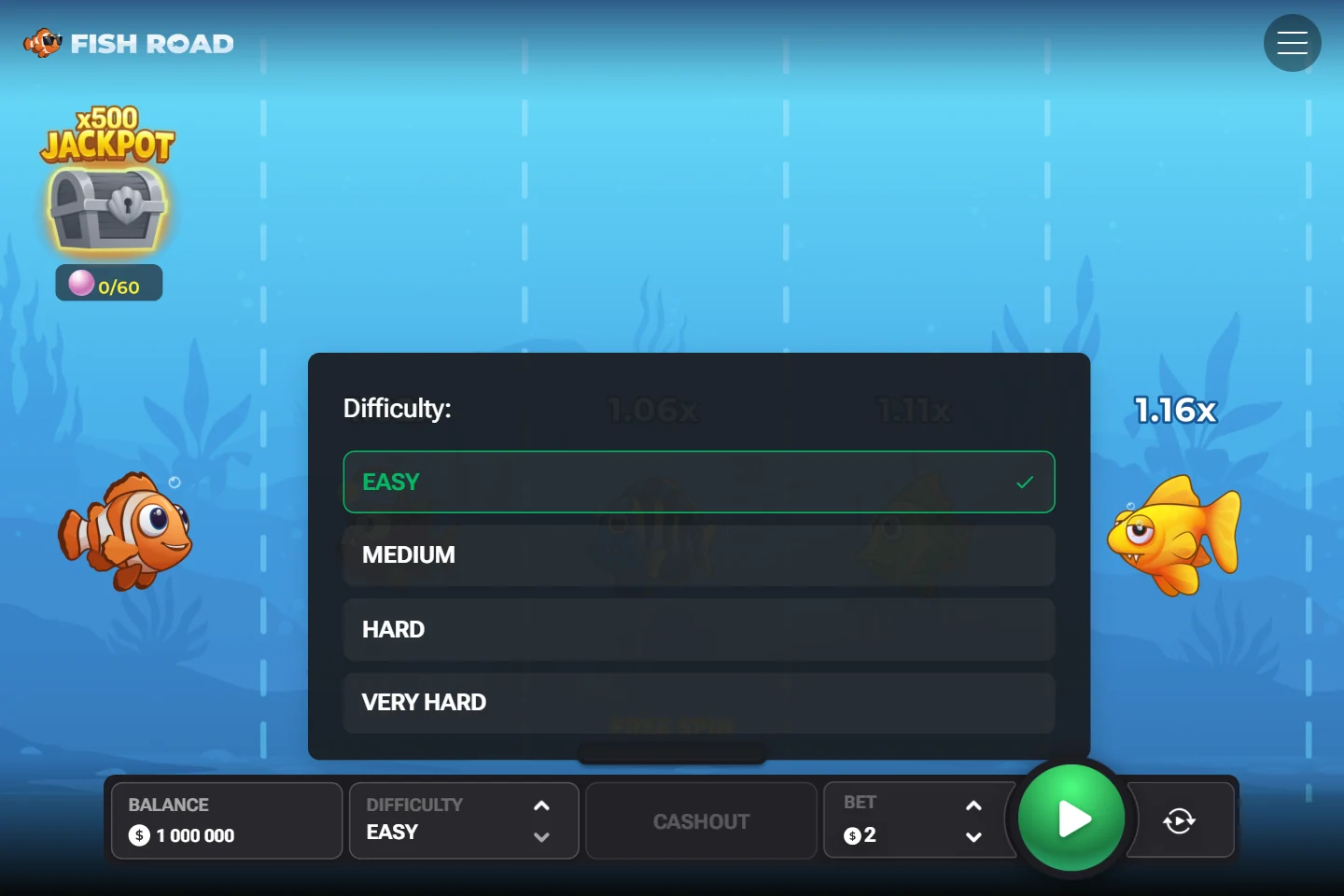
On Easy, the first five coefficients are 1.02×, 1.06×, 1.11×, 1.16× and 1.22×. On Medium, they are 1.11×, 1.27×, 1.46×, 1.69× and 1.97×. A higher offer at the same numbered step does not establish better value: the chance of reaching that step also matters.
Hard starts at 1.22× and reaches 52,067.39× at its final listed position. Very Hard ends at 2,542,251.93×. These startling figures must be read alongside the monetary win cap. Our configuration capped wins at 20,000 USD; multiplying the stake by a huge coefficient without applying that cap gives a misleading cash figure.
Even 0.12 × 2,542,251.93 is 305,070.2316 USD before the cap. That is not an available 305,070 USD payment in the configuration we inspected. We did not reach that final position or test a cap-sized payout. The example explains why a coefficient and a maximum monetary win belong in the same comparison.
At less extreme values, the arithmetic is simpler: 2 USD at Easy’s final 25× would be 50 USD gross. 2 USD at Medium’s final 2,500× would be 5,000 USD gross. Both are conditional examples. Neither says how often a fish gets there.
Do not mix the meaning of the limits
The minimum stake is the smallest permitted new bet in the inspected configuration. The maximum stake restricts that new bet. The maximum win restricts a payment. A final multiplier describes a position on the selected path. These four numbers answer different questions.
For example, choosing a stake below 200 USD does not remove the 20,000 USD win cap. Likewise, a 24-position path does not let you place 24 new independent bets inside one round. You have one active stake exposed to successive decisions until the round ends.
The displayed 96% RTP is a long-run return figure stated by the provider. It does not tell you that the next step has a 96% success chance. Nor does it mean that 96 of the next 100 rounds must win. Do not use an RTP percentage as the missing probability in a cashout calculation.
4. Pearls, jackpots and free-spin progress
The pearl counter is separate from the ordinary cashout. The visible meter runs to 60 pearls. A shell can appear in a round and collecting it advances that meter. In our ten-round recording, one natural pearl appeared and the counter increased from zero to one. We did not complete the meter.
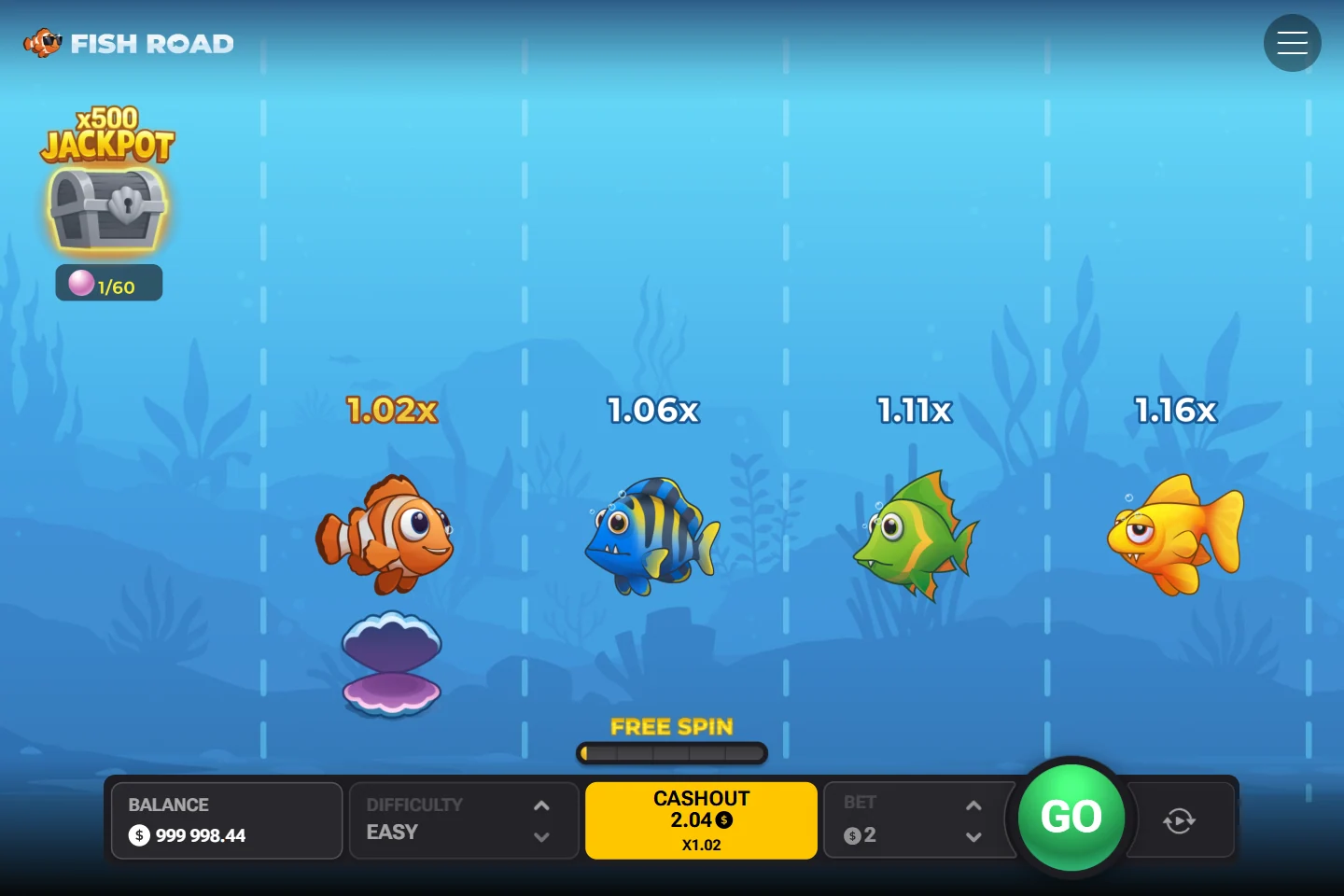
The help lists Mini, Major and Mega jackpot multipliers of 5×, 25× and 500×. We can report those displayed rules, but not a measured jackpot frequency or a completed payout. Do not add a hypothetical jackpot to the return of our sample: the settled ledger contains only the ten ordinary cashouts.
A second progress bar relates to free spins and a roulette selection. It is not the pearl meter. The loaded interface draws that bar against a score of 300. A score unit is not established here as one spin, one dollar or one pearl, so “300 spins guarantee free spins” would be an unsupported reading.
Progress is associated with stake, currency and difficulty. When we changed settings, the displayed bucket changed. Returning to an earlier combination could show its earlier progress. An empty meter after switching difficulty therefore does not, by itself, prove that the previous collection was deleted.
The help describes storing progress for 30 calendar days. We read that statement; we did not run a thirty-day retention experiment. In the demo, a later reconnect reset the virtual wallet while the observed progress and history remained. That reconnect happened after the ten settled rounds used in our published sample.
Treat an unfinished feature as unfinished. Do not increase stakes just to make a partly filled meter feel “worth it”. The future cost of pursuing it is real exposure in an operator game, while the time and amount needed to finish it have not been established by our short recording.
5. Autoplay, mobile controls and restarting
Autoplay has controls for a cashout step and a round count. The menu we inspected offered 10, 20, 30, 50, 75, 100, 150 and 200 rounds. The permitted target positions depend on difficulty. We inspected the settings but did not run an autoplay sequence.
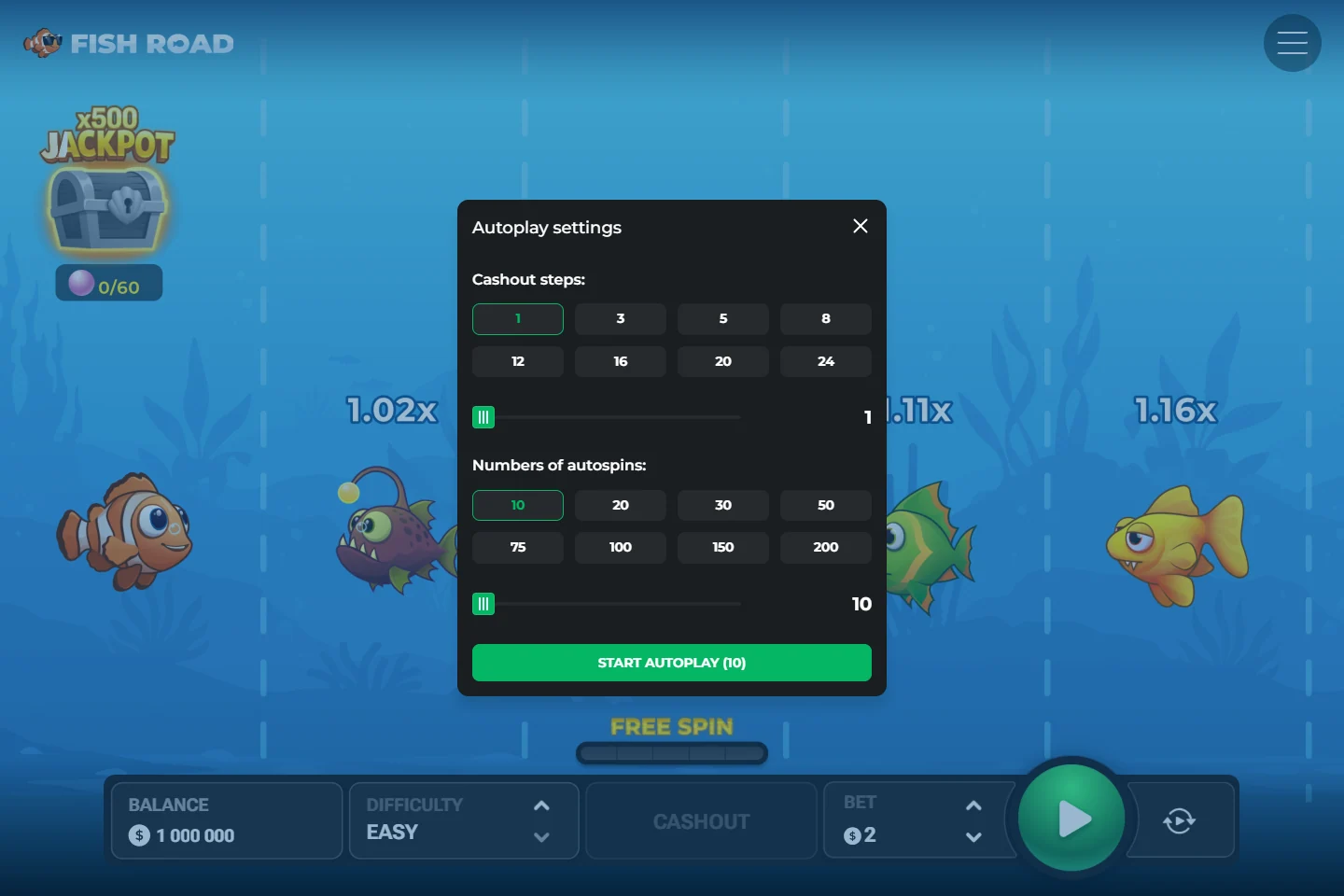
Before enabling it, multiply the stake by the requested number of rounds. At 2 USD, 100 rounds represent up to 200 USD of initial stakes placed over the sequence. Some money may return along the way, but the starting plan still needs a loss limit you understand.
Manual play makes the two decisions more visible: whether to start a new paid round and whether to continue the current one. Changing that rhythm does not establish a better result distribution. We found no verified speed setting that turns the game into a different payout model.
On a narrow screen, the board and controls need enough vertical room. Our demo page supports a full-screen request and an unload button. If the browser does not support full screen for an embedded frame, use landscape or the ordinary provider page. You do not need an unofficial APK to inspect the browser demo.
A restart is not a refund. Keep a note of the settled balance before reconnecting, and inspect history if the last result is unclear. Demo-credit resets are not cash winnings and should not be included in a round ledger. That is why our sample stops at its last verified settlement.
6. What the game sends when you press GO
The ordinary client used a Socket.IO WebSocket connection. Starting a round sent a bet action; advancing sent a step action; collecting sent a withdraw action. The last name refers to an in-game cashout, not a payment from an operator account.
Our Easy sequence produced 10 bet, 50 step and 10 cashout request-and-acknowledgement pairs. There are five step calls per completed round because the first step follows Play automatically. We paired responses on each connection; an acknowledgement number from a new connection must not be mistaken for one from the old connection.
Those 70 gameplay pairs took roughly 74–522 milliseconds between the captured request and its acknowledgement. The measure includes the network, server handling and capture timing. It is not pure ping, a Romanian mobile-network benchmark or a guarantee that an operator will respond as quickly.
The fairness screen showed seed and hash fields, but our inspection did not independently reproduce the complete verification algorithm. Seeing a hash is not the same as proving a distribution. We also found no public information here that predicts the next successful step before it is resolved.
The useful distinction is practical: animations explain the outcome to the player; a settled response establishes what the client recorded. An animated fish continuing to move is not a second unpaid bet. Our strategy study counts ten completed paid rounds, not fifty steps or seventy messages.
How do you get free spins in Fish Road?
The Bet Bar fills through play. When it is full, the rules describe a roulette selection that awards Free Spins. This is the free-spin route inside Fish Road, separate from the 60-pearl jackpot collection. It is also separate from any operator’s deposit promotion.
Keep the same stake, currency and difficulty while comparing the bar before and after a settled round. Otherwise you may be looking at a different progress bucket. Check the wheel’s awarded quantity when the feature opens; do not read a partly filled bar as an already credited free-spin balance.
Our ten completed Easy rounds did not finish this sequence. We cannot give a verified total stake needed to fill the bar, a fixed number of rounds or a measured wheel-award distribution. The interface’s internal score of 300 is not evidence that 300 spins, 300 lei or 300 pearls are required.
For a complete feature record, note the starting progress, each paid stake, the roulette award and the final balance after all awarded spins settle. Until those steps are recorded, the bar is useful for recognising a feature, not for calculating a guaranteed return or a profitable stake increase.
Fish Road questions
What is Fish Road’s RTP?
INOUT’s product page states 96%. That theoretical figure is separate from the 122% return in our ten-round Easy sample and is not a return promised for a session.
Does cashout include my stake?
Yes. A 2 USD stake at 1.22× returns 2.44 USD in total, giving 0.44 USD net.
Is there a Fish Road predictor?
We verified no tool that can predict future steps. A calculator can explain a return or budget; it cannot supply an unknown success probability.